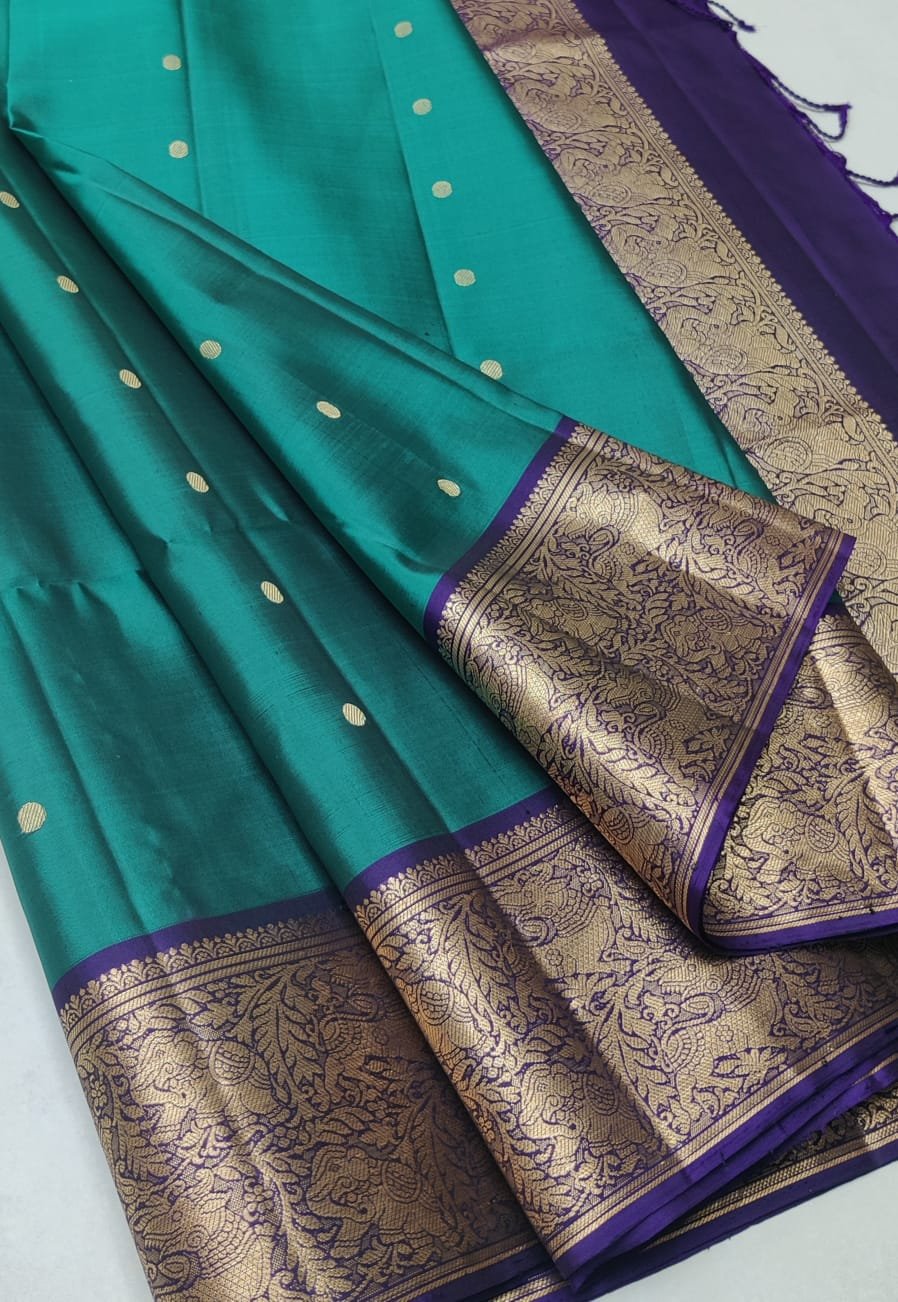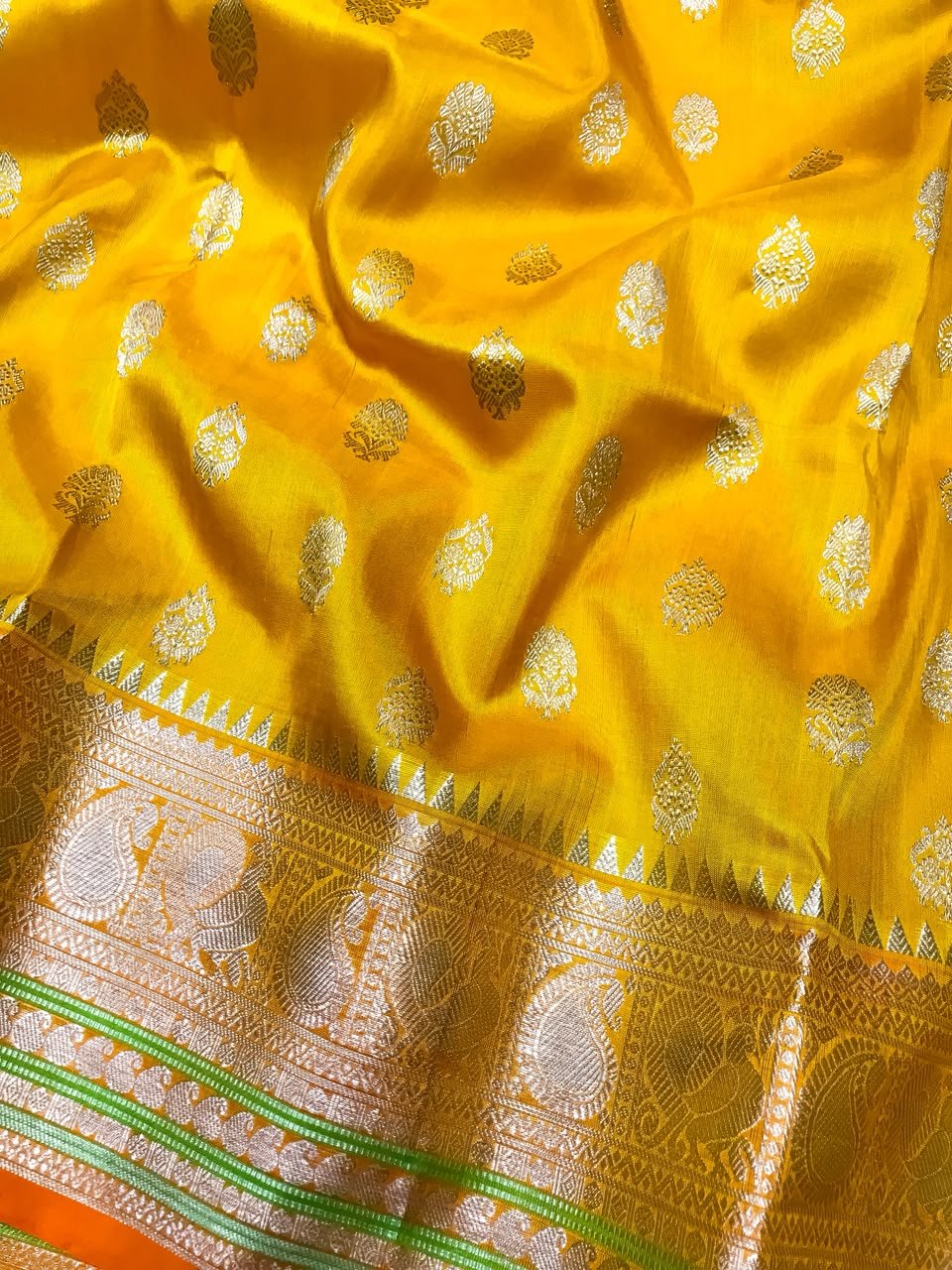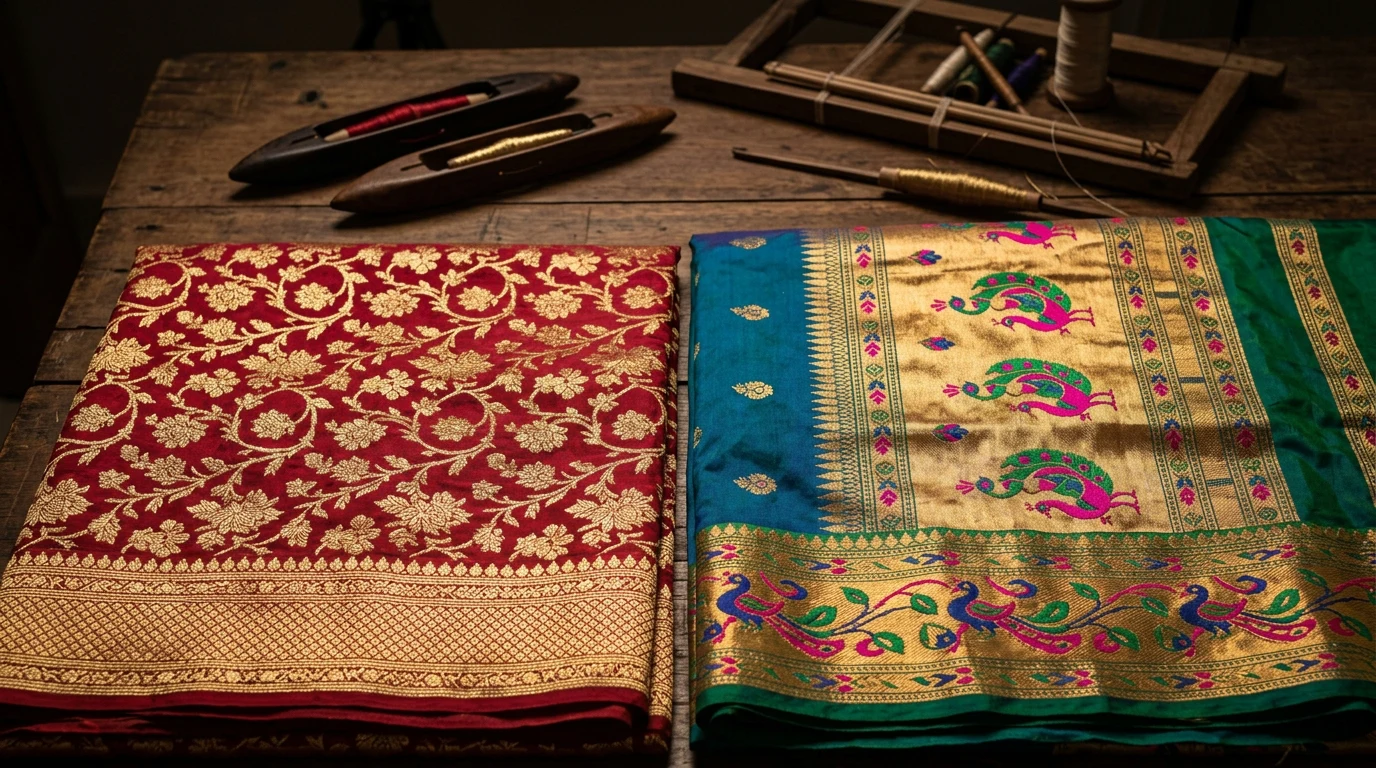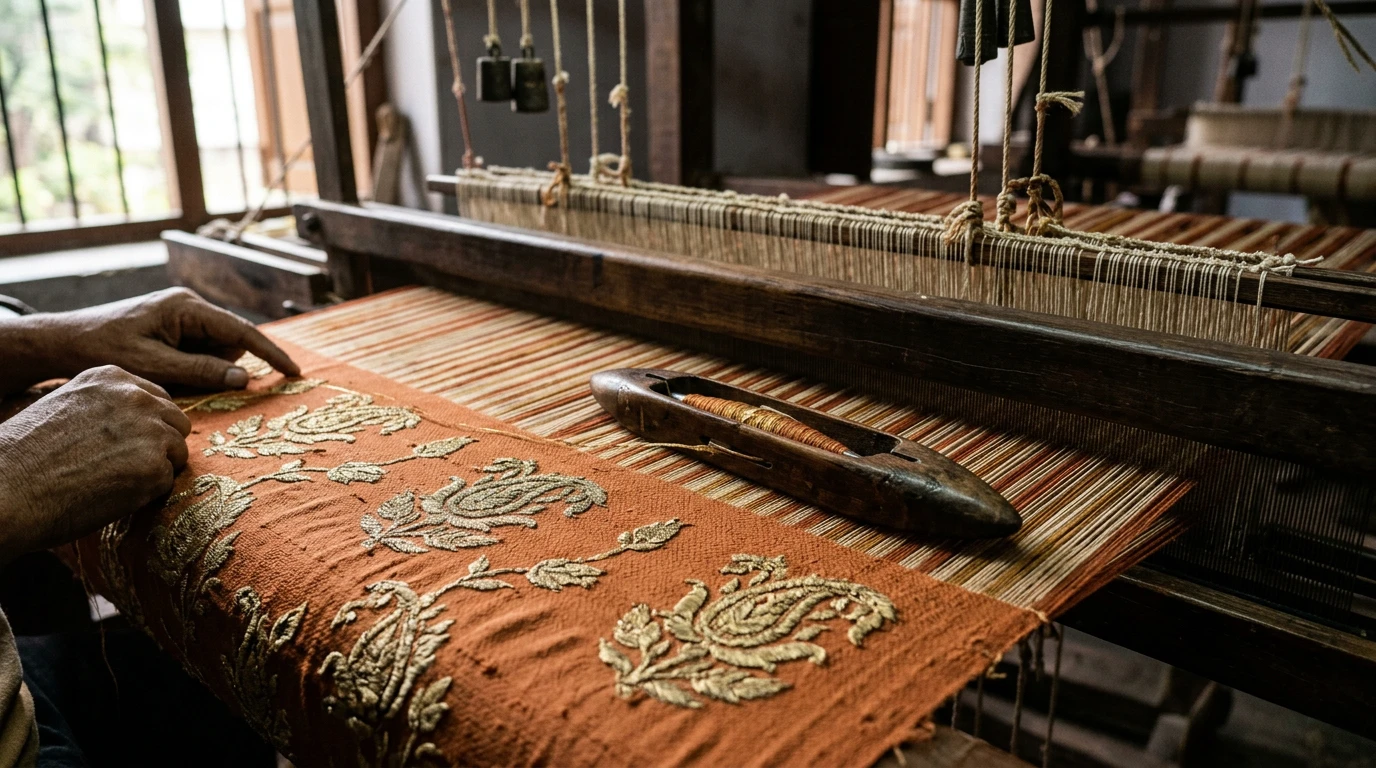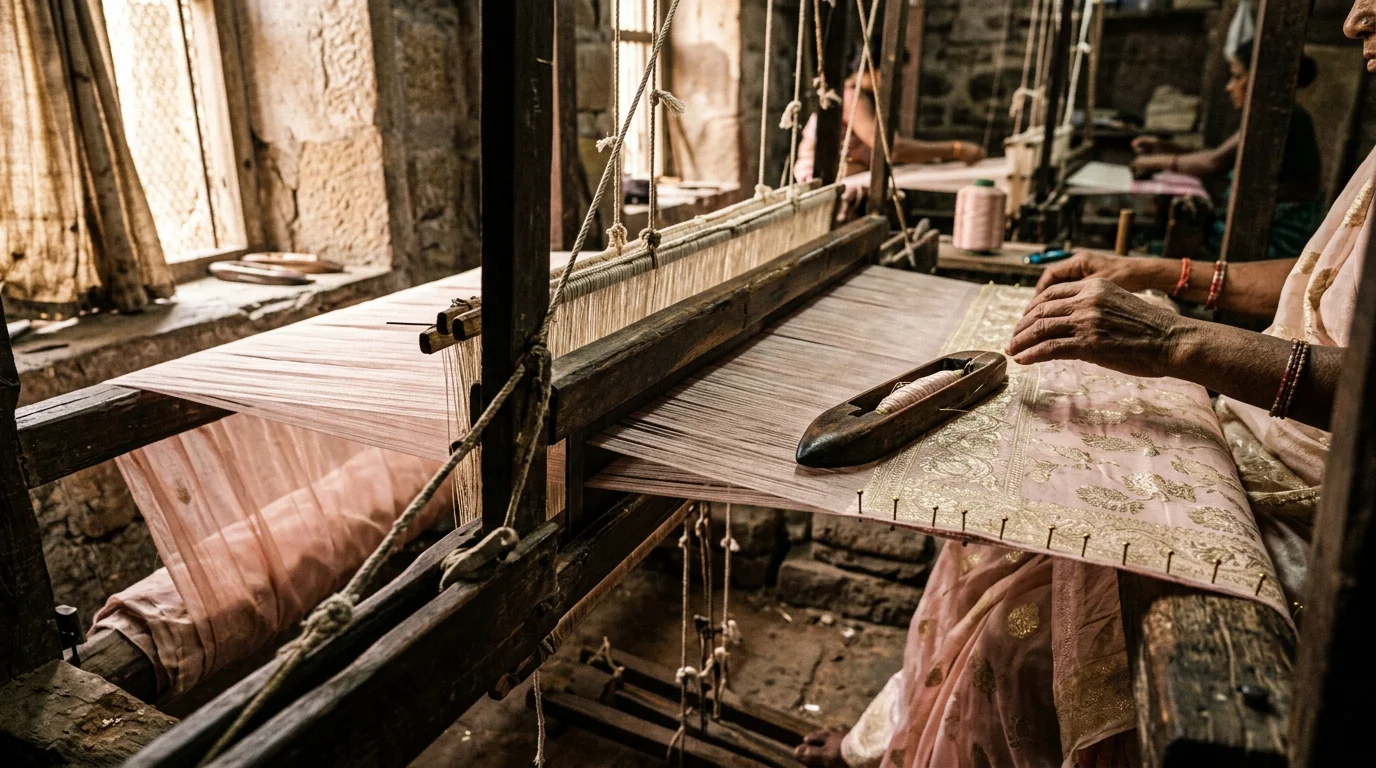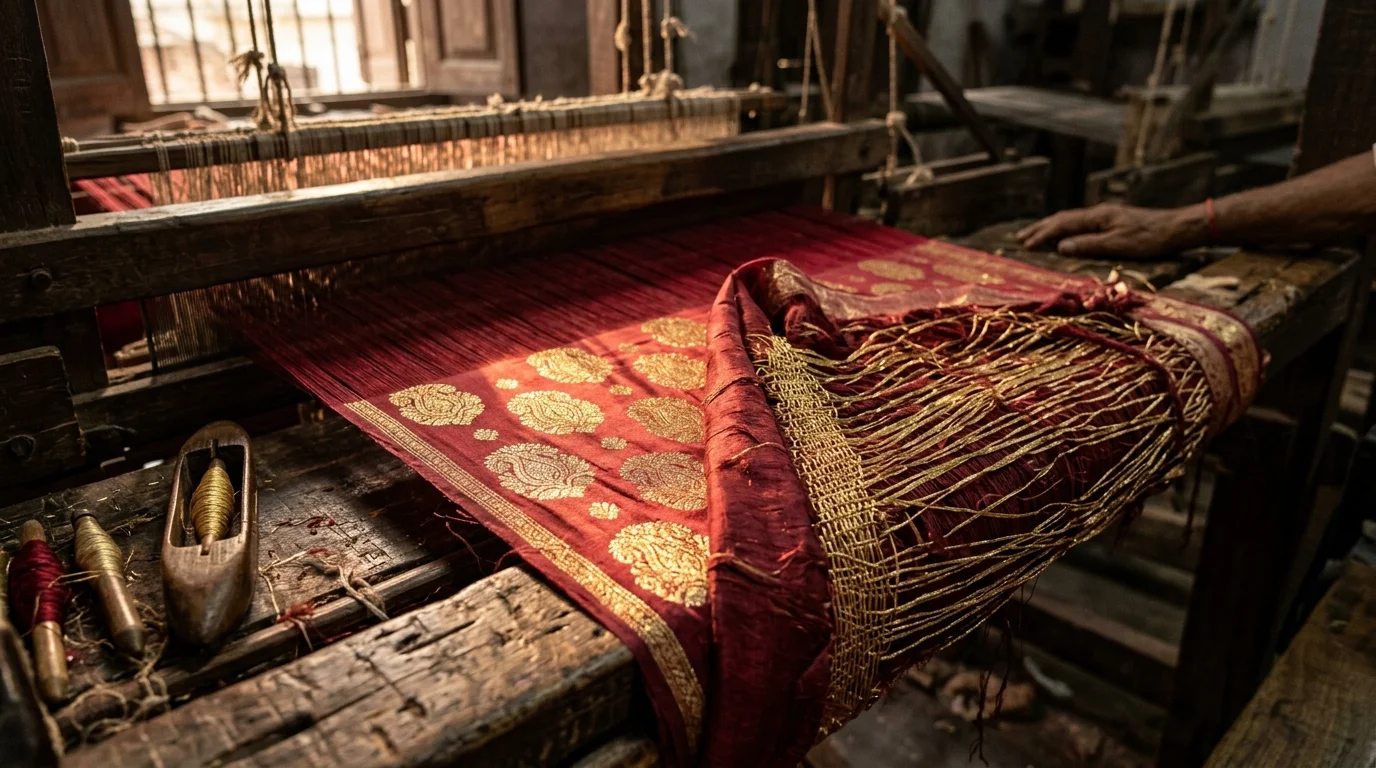
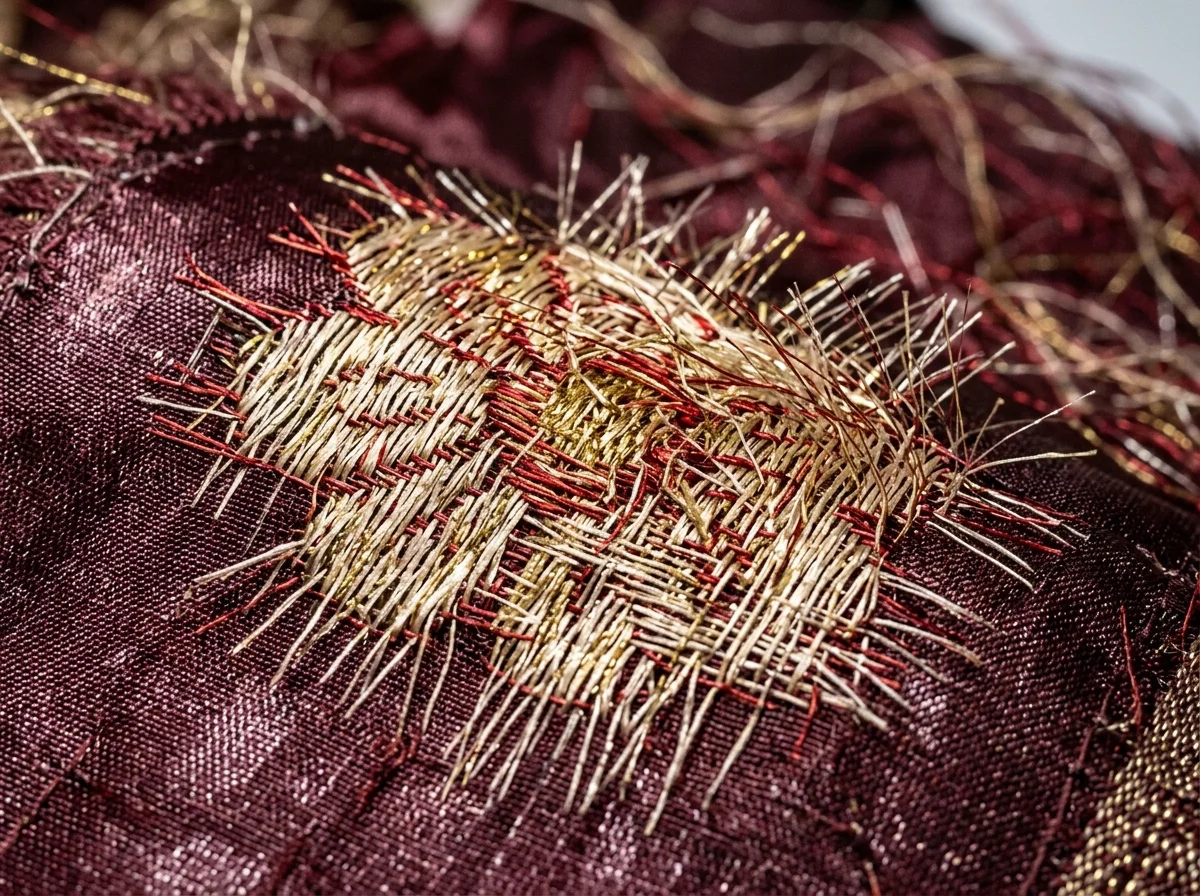
Fekwa weave is an authentic Varanasi handloom technique where a single supplementary zari or resham weft shuttle is thrown continuously across the entire width (araz) of the saree to form surface motifs. Unlike Kadhua—where each motif is individually hand-locked without excess yarn—Fekwa leaves continuous thread floats along the reverse side, which are either left intact or meticulously hand-clipped.
If you are standing in a saree showroom or browsing online wondering why two identical-looking Banarasi sarees carry a ₹40,000 price gap, you are looking at the exact physical dividing line between Fekwa and Kadhua. As weavers whose families have manned the wooden pit looms of Madanpura and Peeli Kothi for generations, we wrote this guide to demystify loom mechanics, expose powerloom replicas, and ensure you never overpay for your bridal heirlooms.
Fekwa Weave: Continuous extra weft float • Single weaver • 4 to 8 days production • Lightweight, fluid drape.
Kadhua Weave: Discontinuous spool-locked motifs • Two weavers in tandem • 4 to 12 weeks • Clean, scratch-free reverse.
1. What Is Fekwa Weave? The Mechanics Behind the Shuttle
The word Fekwa derives from the Hindustani root verb phekna (to throw). In traditional handloom vocabulary, it designates a continuous supplementary weft weaving method executed on a traditional Varanasi pit loom (khaddi).
During the weaving cycle, the base fabric is formed using a pure mulberry silk warp (tana) and weft (bana). To embed motifs like floral butis or latifa butas, the weaver throws an extra shuttle loaded with zari or resham across the entire warp shed in one uninterrupted pass.
Because the pattern thread travels from selvedge to selvedge, it surfaces only where the design requires it. Across the empty background gaps between motifs, the thread floats idle along the back of the saree.
The Cutwork (Katruan) Evolution: On fine fabrics like organza or lightweight Katan silk, leaving long zari floats makes the garment heavy and prone to snagging. Once taken off the loom, these floats are clipped by hand using tiny curved shears—a labor-intensive secondary trade known across Banaras as Katruan or Handloom Cutwork.
2. What Is Kadhua (Kadwa) Weave? The Sovereign Technique
Kadhua (often pronounced Kadwa) stems from the term kadha hua (resembling hand embroidery). It represents the pinnacle of Banarasi handloom artistry and demands an entirely different discipline from the artisan.
Instead of running a single thread across the entire width of the saree, the weaver uses individual spool shuttles (tillis or sirki) for every single motif. Each leaf, petal, or geometric creeper is individually hand-interlocked into the warp threads without extending into adjacent negative space.
Two master weavers must sit side-by-side on the pit loom for up to 8 hours to produce just 2 to 4 inches of dense Kadhua fabric. Because no spare yarn floats between motifs, the back of a genuine Kadhua saree is almost as smooth and clean as the front face—guaranteeing zero loose threads, zero clipped edges, and zero scratchiness against sensitive skin.
Reverse Side Audit: What The Loom Leaves Behind
Turn any Banarasi saree inside out. The underside reveals the physical truth of loom mechanics that marketing descriptions cannot conceal.
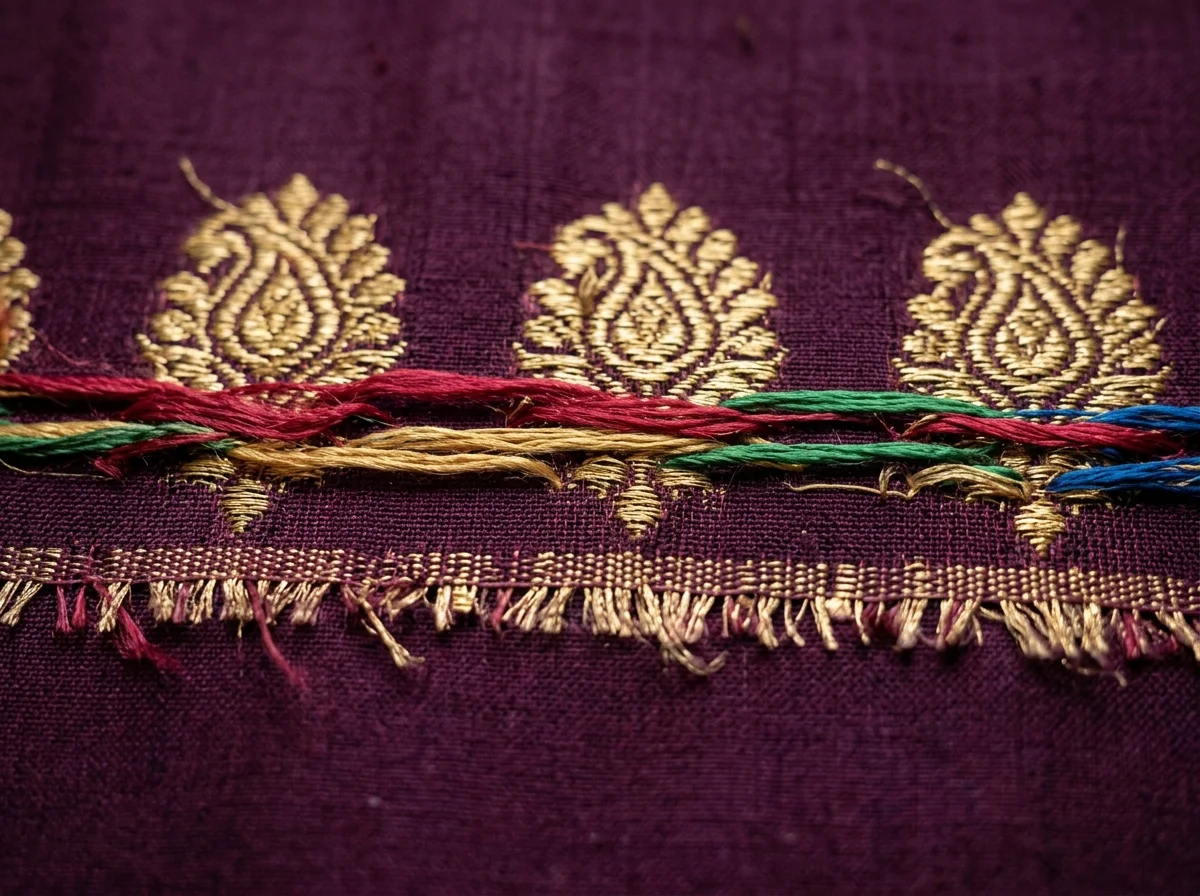 Handloom Fekwa
Visible horizontal weft floats or soft clipped Katruan resham fringes.
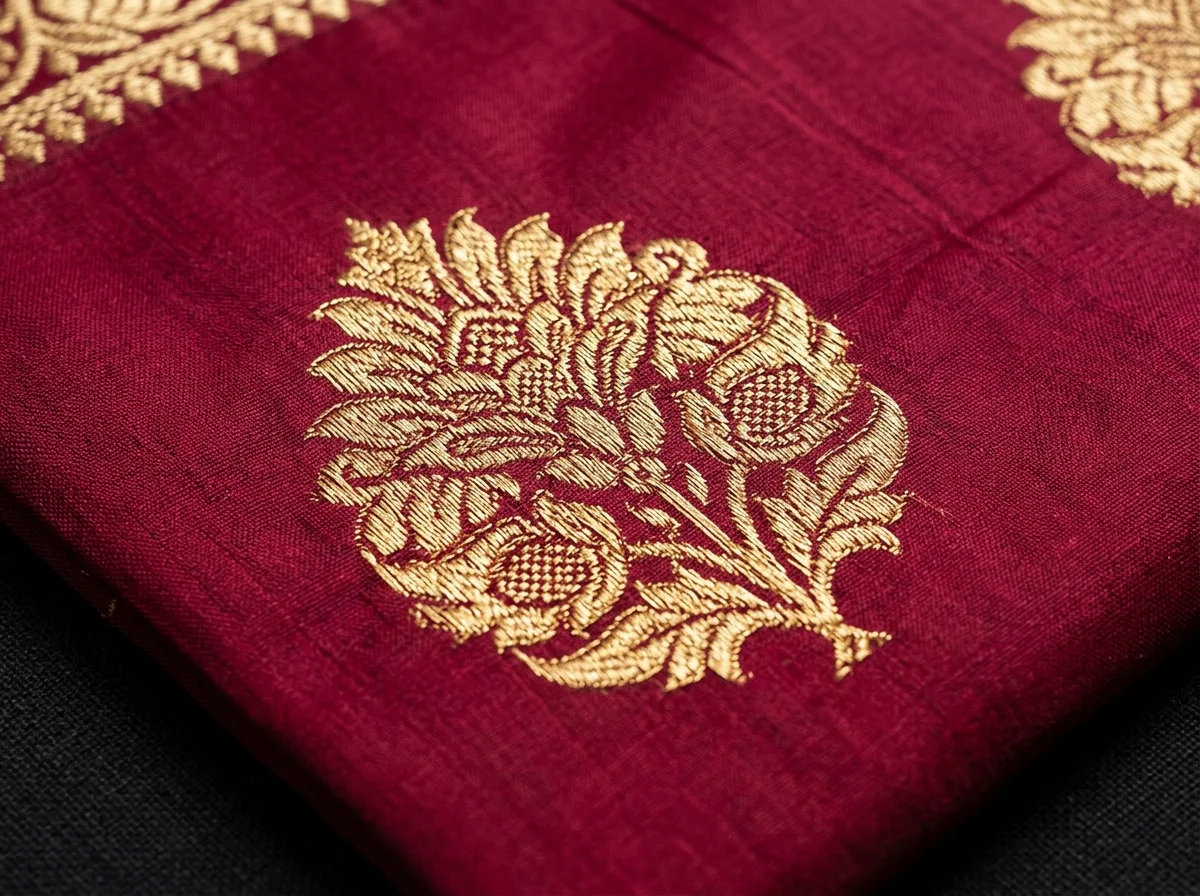 Mastercraft Kadhua
Zero trailing yarn; motifs interlocked seamlessly into the silk ground.
 Powerloom Replica
Laser-straight mechanical cut ends with scratchy synthetic lurex.
3. Technical Comparison: Fekwa vs. Kadhua vs. Machine Cutwork
To determine genuine value before buying, use this structural comparison between the two authentic handloom methods and the modern powerloom imitation:
| Technical Parameter | Handloom Fekwa Weave | Mastercraft Kadhua Weave | Powerloom / Machine Replica |
|---|---|---|---|
| Weaving Method | Continuous extra weft (thrown across full width) | Discontinuous supplementary weft (interlocked per motif) | High-speed electronic Jacquard powerloom |
| Loom Apparatus | Varanasi wooden pit loom with naqsha / harness | Traditional pit loom with manual tilli / spools | Automated rapier or projectile powerloom |
| Reverse Side Appearance | Continuous long floats OR clipped cutwork bristles | Clean, flat, completely locked motifs; zero floats | Ultra-uniform, paper-stiff cut ends with plastic sheen |
| Weaver Engagement | 1 artisan on wooden pit loom | 2 artisans working in synchronization | 0 artisans (1 machine supervisor oversees 6 looms) |
| Production Timeline | 4 to 8 days per saree | 3 to 12 weeks (up to 6 months for Jangla) | 3 to 5 hours per saree |
| Motif Definition | Crisp, slightly flatter silhouette | Embossed, raised 3D relief; sharp structural borders | Flat, mechanical stamp look without dimensional lift |
| Fabric Drape & Weight | Fluid, soft, medium-weight drape | Substantial, regal weight; molds tightly to body | Stiff, rigid drape; flares awkwardly at pleats |
| Varanasi Price Benchmark | ₹9,000 – ₹28,000 (Pure Katan) | ₹32,000 – ₹1,80,000+ (Pure Katan) | ₹1,800 – ₹6,000 (Synthetic mix) |
4. Fabric Specification Card (Textile Standard)
Keep this technical baseline handy when requesting laboratory or certificate details from luxury handloom houses:
5. Master Weaver’s Hands-On Inspection: 4 Physical Tests
Do not rely solely on store lighting or showroom sales pitches. Perform these four physical checks before paying for any Banarasi silk piece:
Test 1: The Reverse Surface Float Audit
Action: Flip the saree over to inspect the reverse side of an ornate corner buta or floral jaal.
Fekwa Finding: You will see long, horizontal yarn bridges connecting adjacent motifs. If the saree was finished via Katruan (cutwork), you will observe soft, short fiber fringes where extra threads were manually trimmed.
Kadhua Finding: The background fabric will look spotless. Every single petal or leaf motif will sit tightly nestled in the silk grain with no trailing threads traveling toward neighboring motifs.
Test 2: The Fingertip Skin-Glide (Scratch Test)
Action: Close your eyes and drag the sensitive inner skin of your wrist across the reverse side of the motifs.
Handloom Fekwa / Kadhua: Feels soft, supple, and naturally flexible. Even trimmed Fekwa resham ends collapse gently without scratching.
Powerloom Cutwork Warning: Cheap powerloom replicas use rigid synthetic lurex threads. The cut edges feel prickly, rigid, and abrasive, causing irritation against the skin and snagging delicate chiffon or georgette blouses.
Test 3: The Selvedge Tension & Pin-Hole Inspection
Action: Inspect the plain outer borders (selvedges) running along the length of the saree.
Handloom Proof: You will discover tiny, uneven pin-pricks spaced every few inches along the edge. These marks come from the wooden templates (kamana or tind) used on pit looms to maintain uniform fabric tension. Powerloom edges are machine-straight and laser-trimmed without tension pricks.
Test 4: The 10-Second Warp & Zari Burn Test
Action: Ask the retailer for a 1-inch stray thread from the unstitched blouse piece hem and burn it with a flame.
Pure Silk Result: Burns slowly with the faint scent of singed hair, curling into a brittle, black spherical bead that crumbles completely between your fingers under zero pressure.
Synthetic Polyester Result: Melts rapidly into a hard, non-crushable plastic droplet with harsh chemical smoke.
Real Zari Check: Real handloom zari uses an authentic silk filament core wrapped in silver alloy and flash-plated in 24k gold. When burned, the pure silk core vanishes into ash, leaving the metallic foil intact.
6. Saree Buyer’s Decision Matrix: Should You Choose Fekwa or Kadhua?
Neither weave is inherently inferior—they serve distinct aesthetic, practical, and investment goals:
Choose Genuine Handloom Fekwa If:
- You seek an authentic, 100% handloom Banarasi Katan silk saree within a smart budget of ₹10,000 to ₹25,000.
- You prefer lightweight, breezy, and flexible drapes for sangeets, cocktail receptions, temple pujas, or festival wear.
- You love elaborate all-over floral jaal patterns that would otherwise cost six figures if woven in Kadhua.
Invest in Mastercraft Kadhua If:
- You are curating a primary bridal trousseau heirloom that will be preserved and passed down across generations.
- Your budget ranges from ₹35,000 to ₹1,50,000+ and you insist on museum-grade textile rarity.
- You refuse any scratchiness or reverse yarn floats that might catch on fine jewelry, ornate clutches, or intricate blouse embroidery.
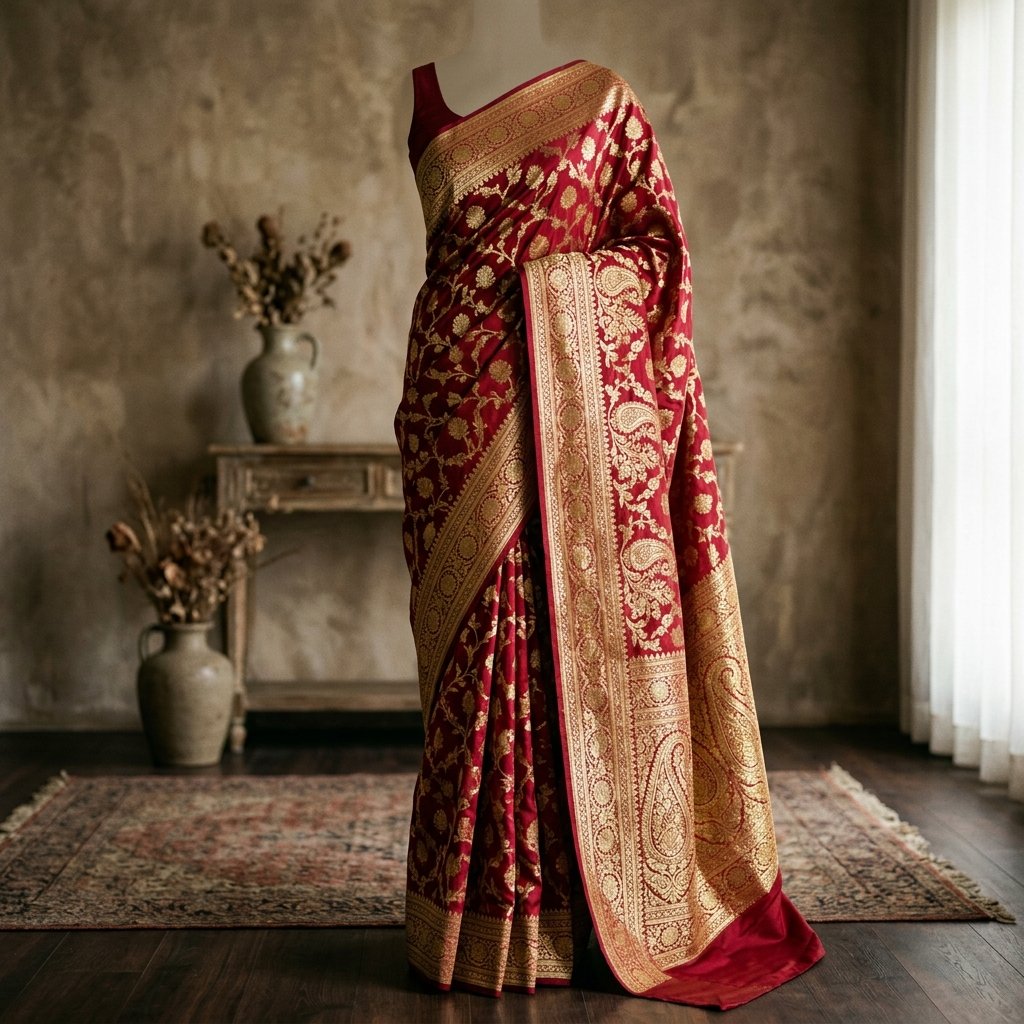
Explore Authentic Handloom Weaves
Each piece is handwoven in Varanasi on registered pit looms and certified with Silk Mark India holograms.
Inspect the Weave Live Before You Decide
Schedule a private 10-minute 1-on-1 Video Drape from our Varanasi loom atelier. Our senior stylist will zoom in on the reverse weave under museum lighting and guide your jewelry pairing.
7. Frequently Asked Questions (FAQ)
What is the primary difference between Fekwa and Kadhua weave?
Fekwa weave uses a continuous supplementary weft thread thrown across the entire saree width, leaving reverse-side floats that are either retained or clipped. Kadhua weave uses discontinuous spools where each motif is hand-locked independently into the warp, leaving a clean, float-free reverse side.
Is Fekwa weave an authentic handloom technique?
Yes, Fekwa is a 100% authentic, centuries-old Varanasi handloom weave. While it weaves faster than Kadhua, an authentic handloom Fekwa saree still requires 4 to 8 days of manual pit-loom labor by skilled artisans and qualifies for the official Indian Handloom Mark.
Does a Fekwa saree feel itchy or uncomfortable to wear?
Authentic pure silk Fekwa sarees with pure resham or tested zari do not irritate the skin. Discomfort typically occurs only in cheap powerloom counterfeit sarees where stiff polyester lurex threads are mechanically cut, leaving sharp, prickly plastic edges.
Why are Kadhua Banarasi sarees substantially more expensive than Fekwa?
Kadhua sarees require two weavers working in synchronization for weeks or months using individual spools for every leaf and petal. The immense labor, zero-tolerance precision, and inability to automate the process command significantly higher artisan wages.
How can I verify that my Banarasi saree is pure silk?
Verify your saree by locating the authorized Silk Mark India QR label and performing a burn test on a loose weft thread. Authentic silk burns slowly with a burnt-hair scent and forms an ash bead that dissolves into black dust when pressed.