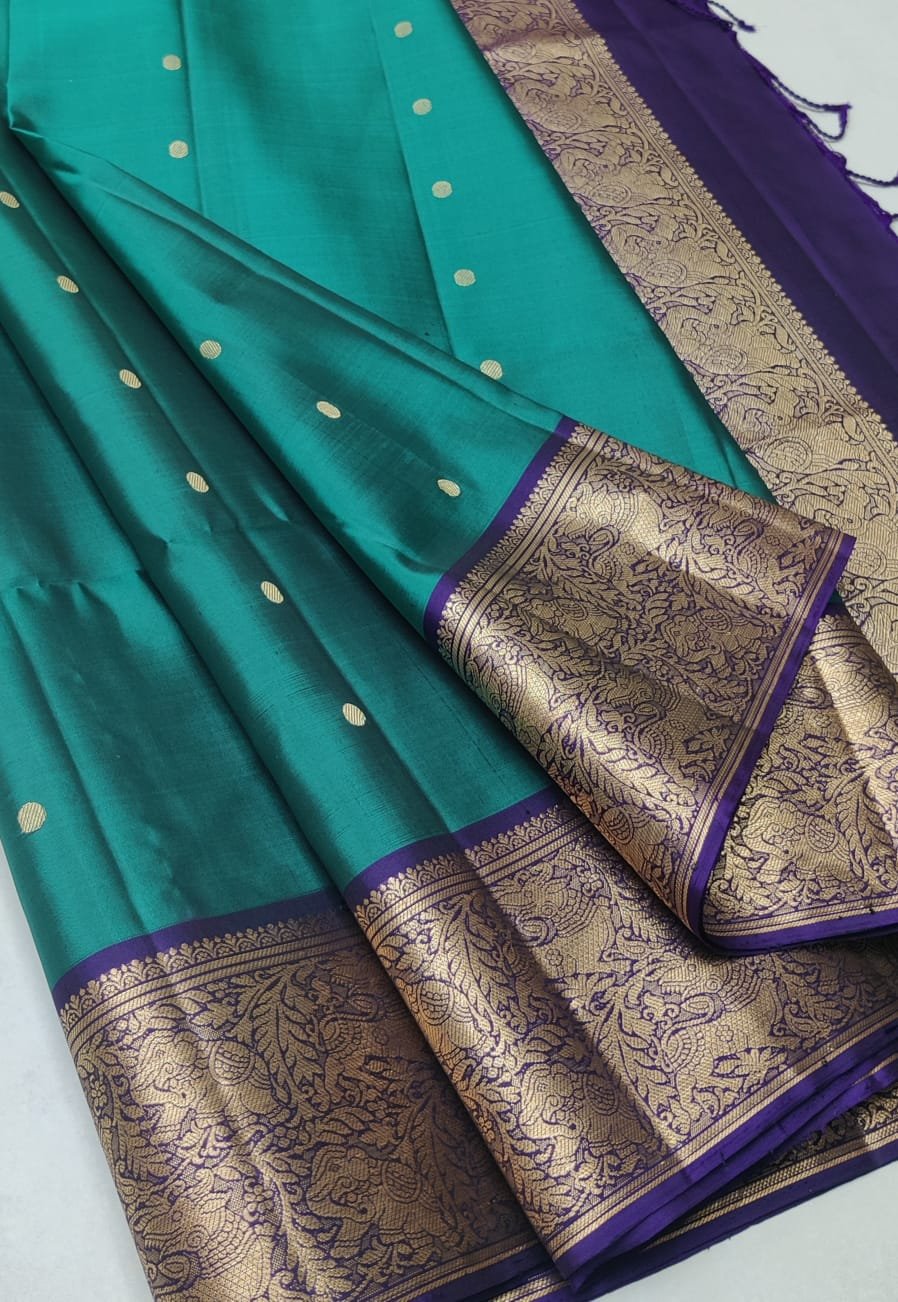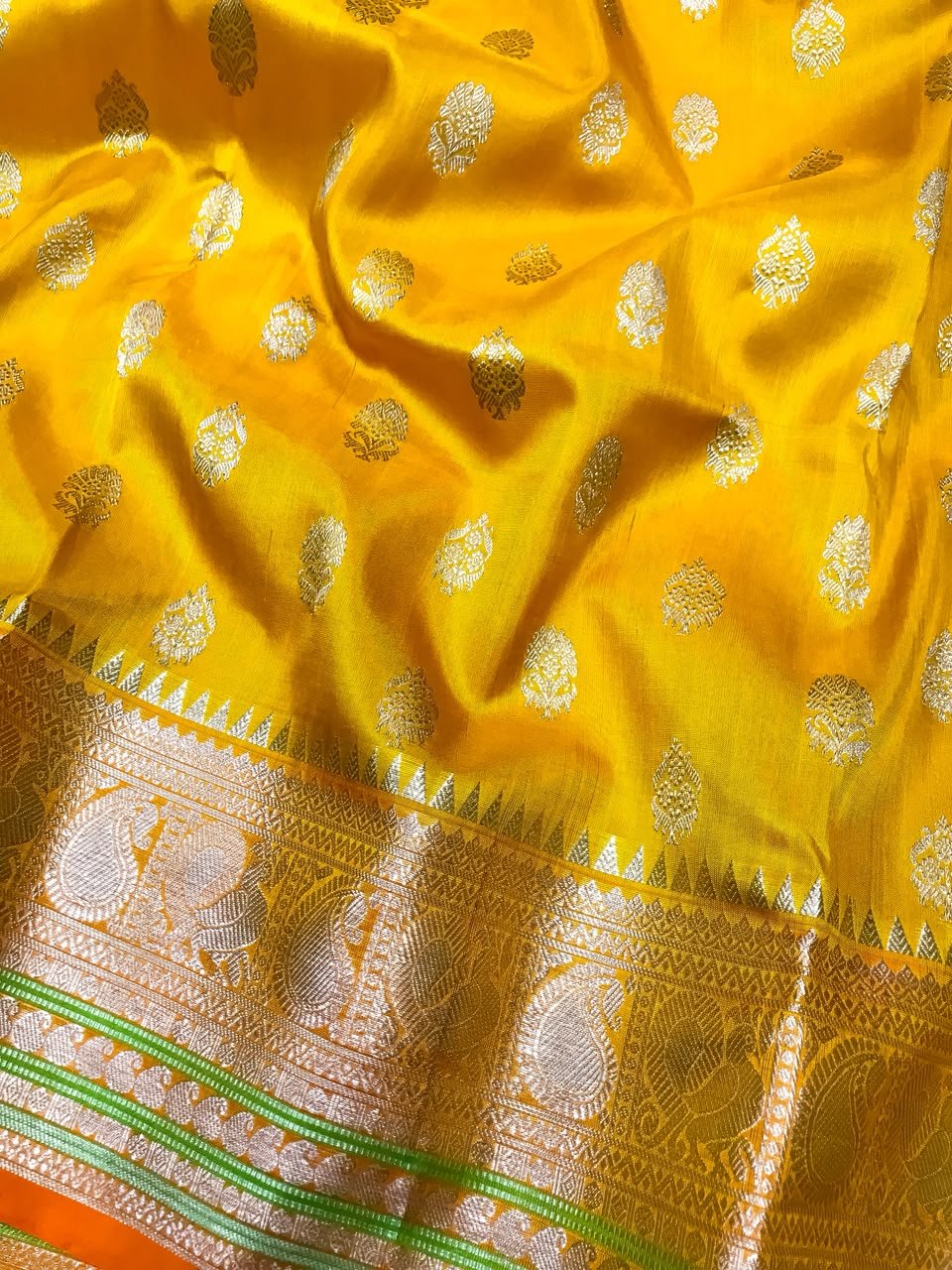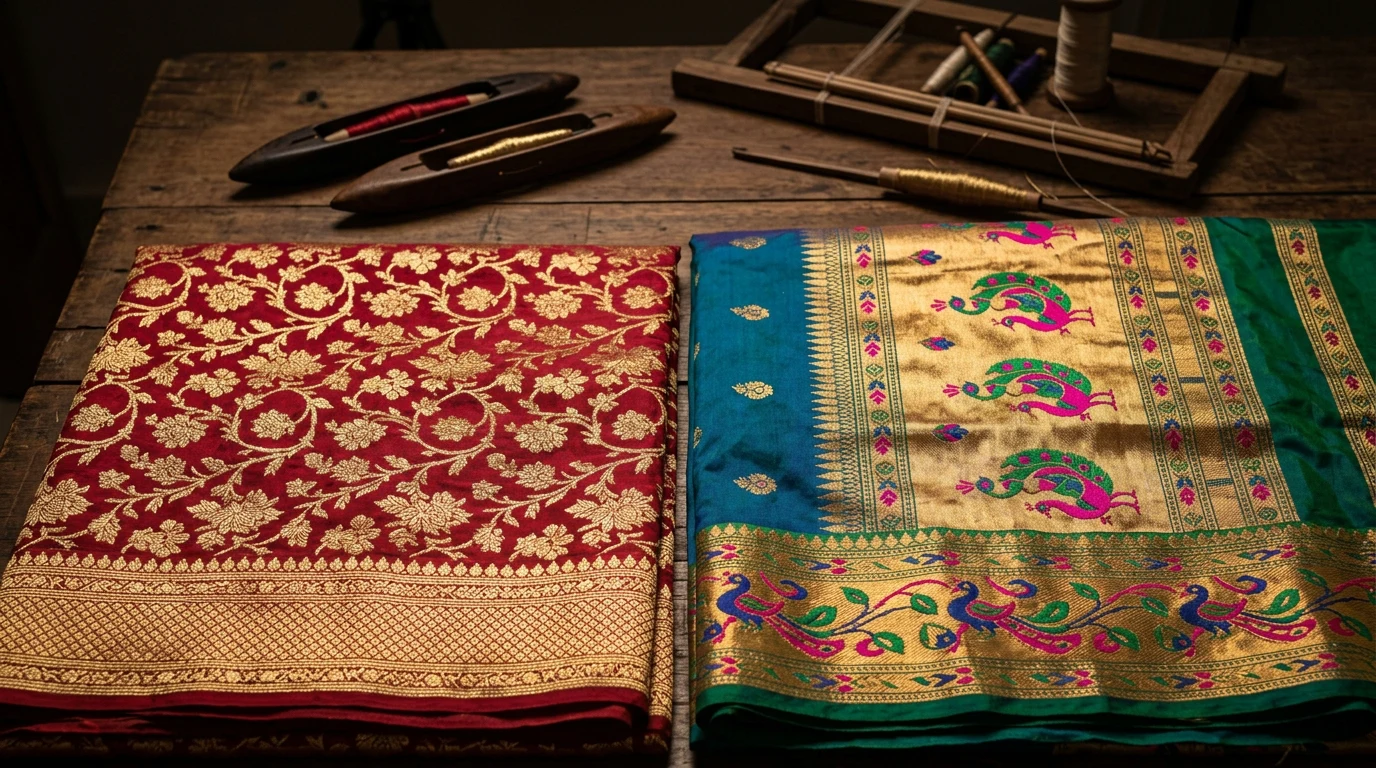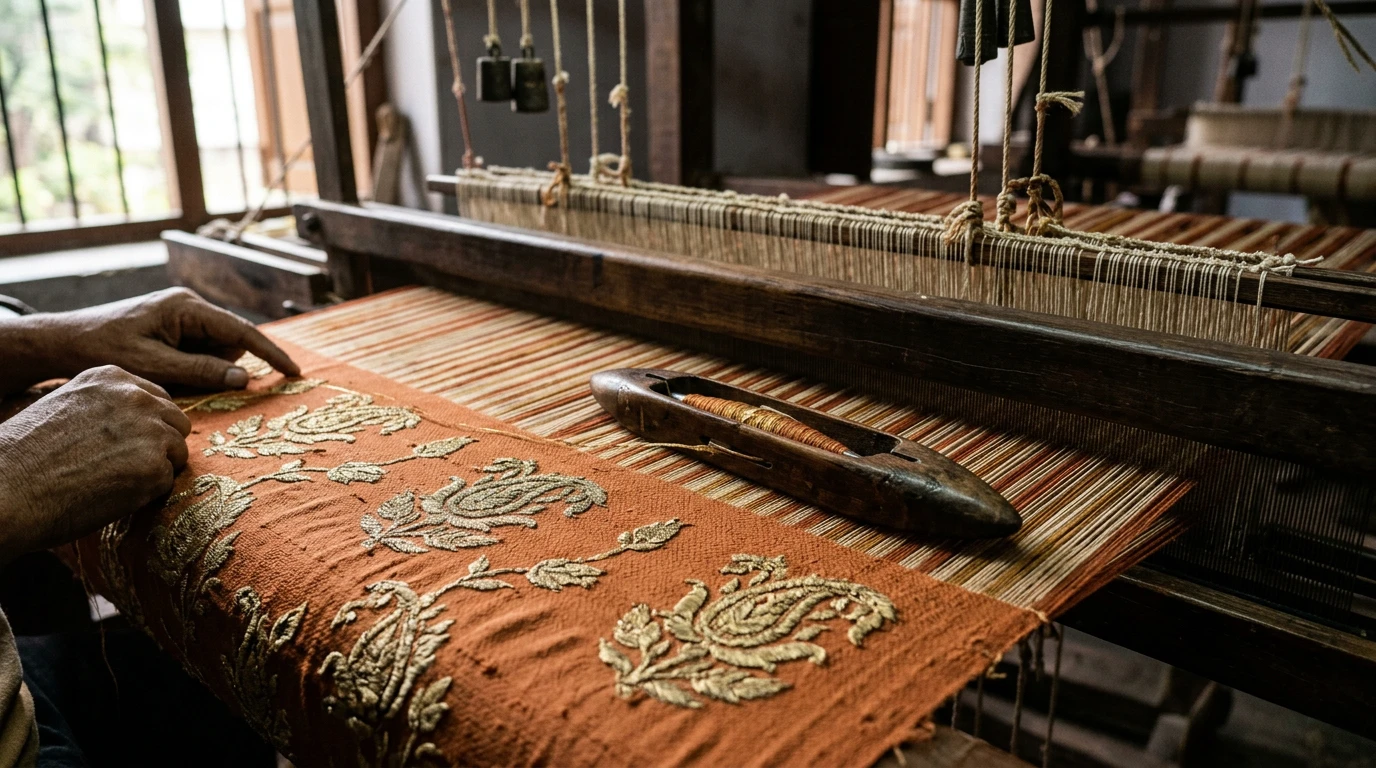
Authentic Chiniya silk is a genuine natural handloom textile woven exclusively from 100% pure mulberry silk yarns using a high-twist crepe construction, but over 70% of modern commercial sarees marketed under this name are semi-silk blends or artificial polyester replicas. Born in the handloom quarters of Varanasi, true Chiniya marries the feather-light, fluid drape of chiffon with the royal tensile strength and pearlescent luster of pure silk.
Step into our weaver karkhanas in Madanpura, Chowk, or Peeli Kothi, and you will hear our master weavers debate the word Chiniya with fierce pride. While Surat powerloom mills flood online marketplaces with ₹2,500 synthetic polyester "art-chiniya," the discerning saree buyer is left trapped in deep skepticism.
Is Chiniya silk pure silk, a clever viscose blend, or cheap art silk? In this candid master weaver’s expose, we pull back the loom curtains to reveal the yarn physics, the piece-dyeing secrets, the separate warp-weft burn tests, and the exact pricing realities of Varanasi’s most misunderstood drape.
Yarn Heritage: Pure Mulberry silk (Bombyx mori) with S/Z crepe twist in both warp (Tana) and weft (Bana).
Dyeing Methodology: Woven in raw un-dyed greige (Kora) and subsequently piece-dyed (Thaan Rangai) in vibrant ombré, pastel, or shibori tones.
Certification Hallmark: Eligible for 100% Silk Mark India certification only when both warp and weft contain zero synthetic or cellulose fibers.
What Is Chiniya Silk? Etymology & Weaver Origins
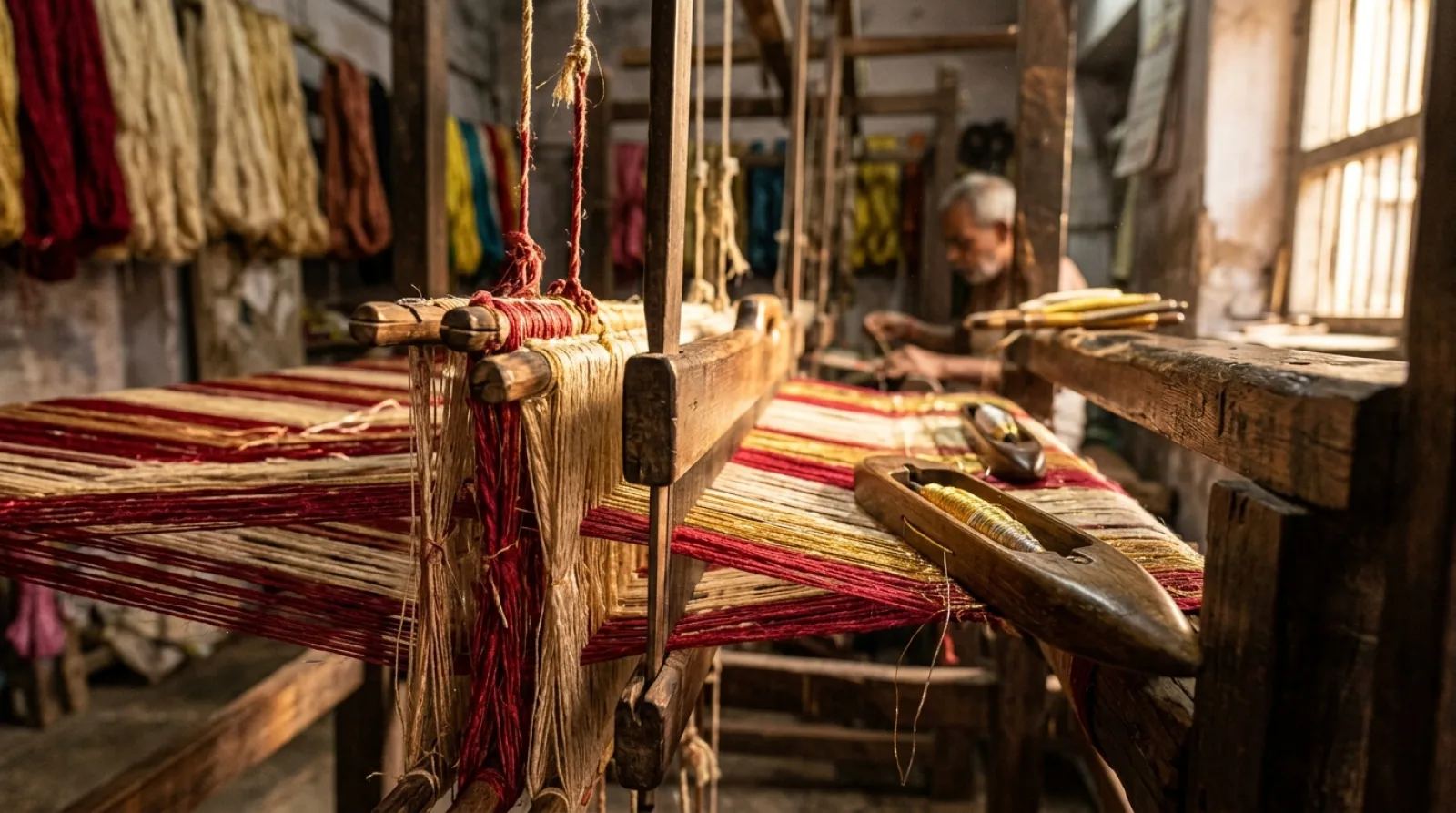
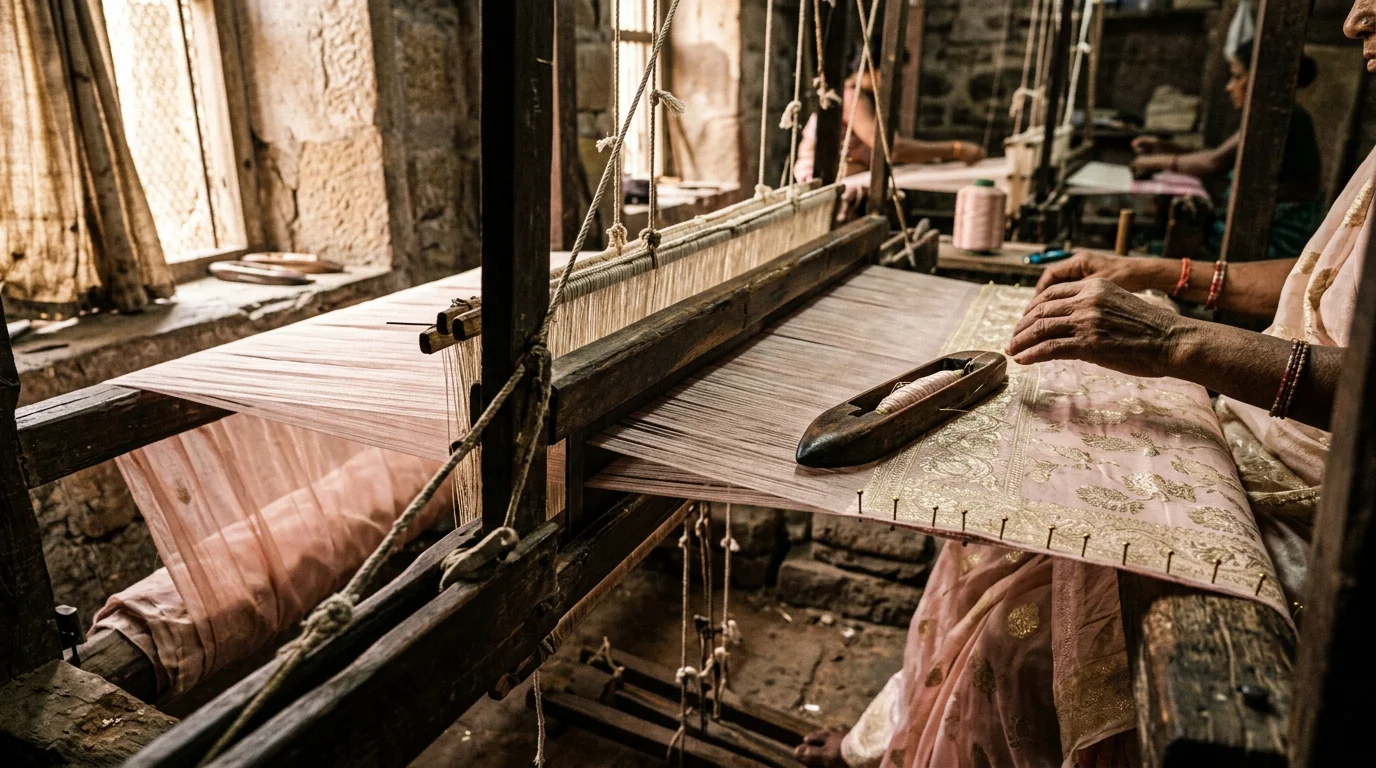
The name Chiniya (historically pronounced Chinia or Cheenia in eastern Uttar Pradesh) traces its linguistic roots to the high-twist crepe silk yarn techniques historically imported through ancient Himalayan trade routes from China. Varanasi’s master weavers adapted this gossamer filament yarn onto indigenous wooden pit looms (gaddha looms) over a century ago.
Unlike heavy Banarasi Katan silk, which relies on dense, tightly packed 2-ply twisted filaments woven from pre-dyed spools, Chiniya was deliberately engineered for fluid grace and tropical breathability. It belongs to the crepe-twist family of silks, carrying a subtle crinkled micro-texture that catches the light from varying angles.
The defining hallmark of authentic Chiniya is its piece-dyeing capability. While traditional bridal Katan must be yarn-dyed before mounting onto the loom, Chiniya is woven in its natural off-white, un-dyed raw state (known locally as Kora Thaan) with zari borders and bootas, and only then dipped into artisanal dye vats.
The "Kora" to Color Miracle: Why Chiniya Takes Dyes Like Magic
Because the pure mulberry crepe yarns are woven untreated, the silk fibroin fibers retain porous open cellular structures on the loom. This unique physical property allows the entire woven six-yard length to absorb room-temperature vat dyes with astonishing uniformity.
Master dyers in Varanasi’s Lallapura cluster submerge the woven saree into natural dye baths, creating hypnotic dual-tone ombrés, delicate pastel lavenders, blush corals, and intricate bandhani tie-dye patterns that are physically impossible on stiff, yarn-dyed Katan. The woven zari—crafted from metallic silver or electroplated threads—repels the silk dye, emerging pristine and radiant against the dyed fabric.
Technical Fabric Specification Card: Handloom Chiniya Silk
The 3 Grades of Chiniya: Pure Silk, Blend, or Art Silk?
Here lies the heart of the consumer’s confusion. In today’s marketplace, the single term "Chiniya Silk" is indiscriminately slapped across three completely different textile grades. Understanding this tripartite division will protect your investment and banish seller deception forever.
Grade 1: Authentic Handloom Pure Chiniya Silk (100% Mulberry)
This is the revered heirloom textile. Both the warp (Tana) running vertically and the weft (Bana) running horizontally are spun from 100% natural mulberry silk. Woven by hand on traditional pit looms, each bootis motif is manually locked using the fabled Kadhua or Fekwa handloom technique.
It feels weightless in the hand, breathes effortlessly in peak Indian summers, carries an understated matte-pearl glow, and comfortably qualifies for an official Silk Mark India tag. This grade starts at ₹14,000 and climbs upward of ₹32,000 for master-woven bridal pieces.
Grade 2: Commercial Semi-Chiniya (Silk-Viscose / Modal Blend)
This is what represents nearly 75% of the sarees currently sold on commercial websites and city retail boutiques for ₹4,500 to ₹9,500. In this grade, weavers mount pure mulberry silk on the warp (Tana) to ensure machine stability, but shoot a regenerated cellulose weft (viscose rayon, modal, or spun silk) across the shuttle.
Because viscose rayon has incredible drape and a cool, slick hand-feel, semi-Chiniya falls exceptionally well on the body. However, it is heavier than pure silk, possesses a slightly glassier sheen, and cannot legally be certified with a Silk Mark India tag. Ethical sellers disclose this as "Semi-Chiniya" or "Silk-Viscose Chiniya"; unethical retailers sell it as "100% pure handloom."
Grade 3: Synthetic "Art Chiniya" (100% Polyester / Surat Powerloom)
Priced between ₹1,800 and ₹3,500, these machine-made fabrics contain zero percent natural silk. They are manufactured on high-speed Chinese rapier looms using continuous filament polyester yarn treated with a chemical pebble-crush finish to simulate crepe texture.
The borders are woven with plastic electroplated metallic film that tarnishes within months, and the reverse side features itchy, cut-thread fringes. In Indian heat, these synthetic drapes trap sweat, cause static electricity cling, and melt into toxic plastic when exposed to flame.
| Inspection Parameter | 1. Pure Handloom Chiniya | 2. Semi-Chiniya (Blend) | 3. Art Silk (Powerloom) |
|---|---|---|---|
| Fiber Composition | 100% Pure Mulberry Silk (Warp & Weft) | Pure Silk Warp + Viscose/Modal Weft | 100% Polyester / Synthetic Filament |
| Weave Mechanism | Varanasi Wooden Pit Loom | Handloom or Semi-Automatic Loom | High-Speed Jacquard Powerloom |
| Silk Mark Eligibility | 100% Eligible & Certified | Strictly Prohibited (Illegal) | Fraudulent if Affixed |
| Burn Test: Warp (Tana) | Organic burning hair; crushes to ash | Organic burning hair; crushes to ash | Melts into hard plastic bead |
| Burn Test: Weft (Bana) | Organic burning hair; crushes to ash | Burns like paper/wood; grey ash | Black toxic smoke; rock-hard bead |
| Bleach Solubility Test | Dissolves 100% in 20 mins | Warp dissolves; weft threads remain | Zero dissolution; intact threads |
| Loom Selvage Edge | Organic pin-holes (Kanji marks) | Variable pin-marks or flat edge | Uniform heat-sealed or glued edge |
| Average Saree Weight | 420 – 550 grams (Feather-light) | 550 – 720 grams (Heavier drape) | 350 – 480 grams (Stiff/slippery) |
| Fair Price Range (INR) | ₹14,000 – ₹32,000+ | ₹4,500 – ₹9,500 | ₹1,800 – ₹3,500 |
| Official Indian HSN Code | 5007 20 10 (Handloom Silk) | 5408 (Man-made blended fabric) | 5407 (Synthetic polyester fabric) |
The Buyer’s Hands-On Inspection Checklist: 5 Tests Before You Pay
Never rely solely on a showroom label or online product title. As master weavers, we instruct our own patrons to execute these five actionable tests to verify authenticity with certainty:
1. The Dual-Direction Burn Test (Warp vs. Weft)
Most deceitful sellers test only the vertical warp fringes because they know the warp contains real silk! Snip 3 loose threads from the vertical fringe (Tana) and 3 threads from the horizontal side border (Bana) separately. Pure Chiniya silk burns slowly with the characteristic pungent smell of burnt hair or feathers, extinguishing immediately when removed from flame, leaving a brittle charcoal bead that disintegrates into fine powder between your fingertips. If the horizontal weft burns briskly with an orange flame, smells like charred newspaper, and leaves soft grey ash, you are holding a semi-Chiniya viscose blend. If it melts with black chemical smoke into a hard, uncrushable plastic ball, it is polyester art silk.
2. The Household Liquid Bleach (Sodium Hypochlorite) Test
Natural silk consists of pure animal protein (fibroin), which is completely dissolved by chlorine oxidizers. Take a few sample yarns from your saree and drop them into a small cap filled with standard household liquid bleach. Within 15 to 20 minutes, pure mulberry Chiniya silk will completely liquefy and disappear into the clear liquid. If the warp threads vanish but the horizontal weft threads remain fully intact, it confirms a semi-silk viscose blend. If none of the threads dissolve, the fabric is 100% artificial polyester.
3. The Reverse-Side Kadhua Knot vs Buzz-Cut Inspection
Flip the pallu or body motifs inside out. Authentic handloom Chiniya weaves employ the Kadhua technique, where each boota motif is hand-engraved and anchored into the warp with an individual miniature wooden spool (tilli), leaving no loose horizontal floats between motifs. If you see thousands of tiny, mechanically sheared wire-like cut threads across the reverse side, the saree was woven on an industrial cutwork powerloom.
4. The Organic Loom Selvage Check (Kanji Pin-Marks)
Inspect the plain un-woven borders (selvages) running along the top and bottom edges of the saree. Traditional handloom pit looms utilize wooden tenter sticks equipped with sharp iron pins (known locally as kanji) to maintain consistent horizontal warp tension. True handloom Chiniya sarees always feature small, organically spaced pin-holes every few inches along the selvage. Machine powerloom sarees have laser-straight, stiffly glued, or thermally melted edges with zero tenter marks.
5. The Refractive Luster & Temperature Hand-Feel
Gently rub the fabric between your hands for ten seconds. Authentic natural silk warms rapidly against skin friction and exudes a subtle, organic two-tone pearlescent refraction under sunlight due to its triangular protein structure. Artificial polyester remains cold to the touch and generates a harsh, oily plastic glare under indoor light.
Chiniya Silk vs Katan Silk: Which Weave Should You Choose?
Patrons often ask us in our atelier: "Should I choose a royal Katan silk or a fluid Chiniya silk for my celebrations?" The choice depends entirely on your silhouette preference, the climate, and the formality of the occasion:
- Choose Katan Silk if: You are seeking a quintessential Banarasi bridal masterpiece with architectural grandeur, crisp pleats, heavy gold zari Kadwa work, and generational heirloom weight. Katan is unbeatable for winter weddings, formal pheras, and classic royal ceremonies.
- Choose Chiniya Silk if: You prioritize fluid, body-hugging movement, feather-light weight (under 500g), and modern pastel or ombré aesthetics. Chiniya is the undisputed queen for summer destination weddings, cocktail soirees, mehendi functions, and sangeet celebrations where effortless dancing is non-negotiable.
Inspect Authentic Chiniya Weaves in Real Time
Our senior textile specialists host live 1-on-1 video consultations directly from our Varanasi weaving workshop. Inspect reverse Kadhua threads, verify Silk Mark certificates, and review draping under daylight.
Frequently Asked Questions: Chiniya Silk Unveiled
Is Chiniya silk pure natural silk, art silk, or a blended fabric?
Authentic Chiniya silk woven in Varanasi handloom clusters is 100% pure mulberry silk crafted with high-twist crepe yarns. However, over 70% of commercial sarees marketed today as "Chiniya silk" are semi-silk blends combining a pure silk warp with a viscose rayon or modal weft, while cheap machine replicas under ₹3,500 are 100% synthetic art silk (polyester).
Can a Chiniya silk saree receive an authentic Silk Mark India certificate?
Yes, but only if both the warp (Tana) and weft (Bana) are 100% natural silk. Blended semi-Chiniya sarees containing viscose, modal, or rayon wefts are strictly prohibited from carrying the certified Silk Mark tag under Central Silk Board regulations.
How does Chiniya silk differ from traditional Banarasi Katan silk?
Katan silk is crafted from heavy 2-ply twisted yarn-dyed filaments that produce a crisp, structured architectural drape. In contrast, Chiniya silk utilizes a fine crepe-twist weave woven in the un-dyed raw greige state, yielding a lighter, fluid, translucent drape that is piece-dyed in vibrant pastel and ombré shades after weaving.
What is the real market price range for an authentic handwoven Chiniya silk saree?
Genuine handloom pure Chiniya silk sarees woven on Varanasi pit looms with authentic tested or silver zari range from ₹14,000 to ₹32,000+. Commercial semi-Chiniya silk-viscose blends retail between ₹4,500 and ₹9,500, while powerloom polyester replicas sell for ₹1,800 to ₹3,500.
What is the official HSN code for handloom pure Chiniya silk sarees?
The official Harmonized System of Nomenclature (HSN) code for woven fabrics of pure handloom silk is 5007, specifically sub-heading 5007 20 10 in India, which applies to fabrics containing 85% or more by weight of pure silk woven on handlooms. Blended semi-Chiniya fabrics containing man-made viscose or modal fall under HSN code 5408, and synthetic polyester art silks fall under HSN code 5407.